What lies ahead for Williams following the Baku B-spec results that brought varied outcomes?
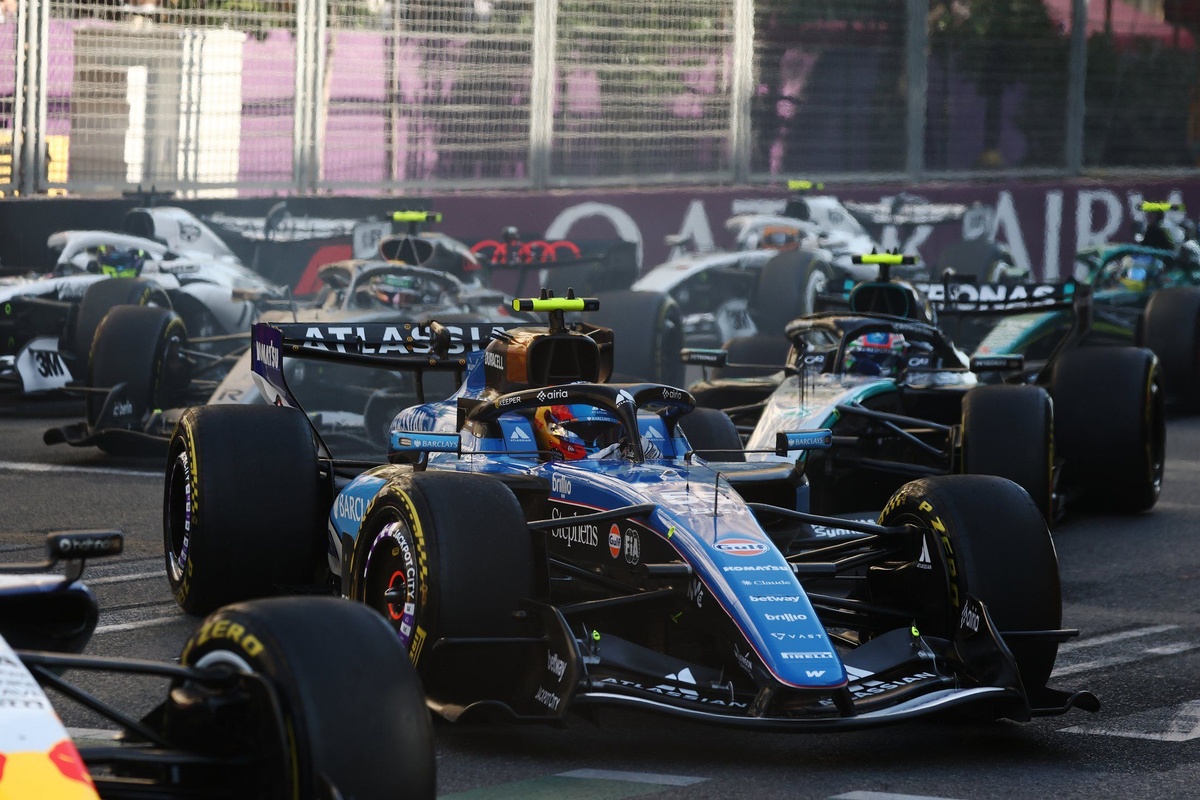
The Baku weekend was truly a mixed experience for Williams. They reached Q3 for the first time in 2026, but were unable to start there due to a grid penalty imposed on Carlos Sainz. They managed to score points for the first time since Monaco, albeit with a bit of luck, while Alex Albon unfortunately crashed out.
Azerbaijan was a critical weekend marked on Williams' calendar as they finally introduced upgrades to an FW48 that had gone without significant enhancements for several months. The team from Grove presented a completely new chassis that met the necessary weight requirements, along with a new floor and various aerodynamic components.
The car's long-run performance during FP2 appeared promising, opening a previously closed door to the midfield battle that includes teams like Haas, Racing Bulls, and Audi.
In qualifying, Sainz secured ninth place, but a grid penalty pushed him down to 14th behind Albon. From the tail end of the pack, it seemed like a long-awaited opportunity to earn points was slipping away until Franco Colapinto collided with Pierre Gasly and Lando Norris during a restart.
"It has taken a monumental effort to bring the updates we have this weekend, and it’s gratifying to walk away with a point," said team principal James Vowles. "You could see we lacked pace in that first stint, and we need to investigate that because it was a crucial part of the race where we couldn't advance."
The point scored for 10th place was a recognition of the hard work put in at the factory, but did the Williams B-spec truly meet expectations? "I believe it’s the exact step we anticipated," Albon asserted. "Perhaps we didn’t foresee Q3, to be fair. But yes, it has placed us in a midfield tussle."
Sainz added: "Our initial impression is that the car feels somewhat faster. However, we were so far behind that despite the significant upgrade, it still feels like we’re playing catch-up. So, as expected, no huge surprises in terms of pace, but a solid step forward."
James Vowles, Williams
Another consideration is that Baku was particularly suited to Williams, unlike the circuits in Malaysia’s Sepang and Singapore, which will place a greater emphasis on downforce. Thus, coming away with a point and a DNF feels like a partial missed opportunity if it suggests that Williams may struggle again in the upcoming triple-header.
"This track, even without the update, would have been favorable for us," Albon stated. "Malaysia will be significant to gauge where we stand on a circuit that demands more downforce. We also have a few days to truly comprehend the package we have now.
"If you look at the broader picture, we will enhance the car's speed by optimizing it. However, we will likely be slower in comparison to the rest of the grid, as that track won't suit us. Anticipate us to fall back in Malaysia, and perhaps in Singapore, we can find ourselves somewhere in the middle."
Regarding Albon’s crash that brought out the safety car on lap 31, he accepted responsibility for outbraking himself but felt it also highlighted a significant weakness within Williams that has persisted across regulations.
"It was peculiar," he explained. "I braked a bit later, but not excessively so. Then a strong gust of wind hit. I thought I might run a little wide, but I never imagined I would hit the wall.
"I certainly must accept my role in that instance, but at the same time, we’ve encountered these issues before. We know our car tends to lift the front wheel, and we can end up on three wheels. We understand that when we brake slightly late, we risk that three-wheeling. Unfortunately, when that happens, the penalty for front locking is substantial for our car. It’s part of the game.
"Definitely, with the wind gust and braking late at the same time, it just pushed it over the edge. It wasn't a huge difference; just a few meters, but that’s too much."
Alexander Albon, Williams
Fans of Williams may have anticipated more from such a long-awaited upgrade on a circuit that has historically favored the team. However, 2026 appears to be a season lost for them, at least in terms of track performance, as they find themselves in ninth place in the standings.
It might be more productive to view the overhaul of their chassis and the enhancement of aerodynamic performance as a test of resilience for the team. It serves as a demonstration for Vowles that the Grove-based team is now more capable of integrating new components than it was a year ago, and a way to recalibrate as the 2027 car project gains momentum.
With the latest chassis expected to carry over into the 2027 season, that’s already one major hurdle out of the way.
"I’m confident you will see us making progress now that this significant rule change is behind us," Vowles told Sky. "There’s an aerodynamic change for next year, as well as a power unit change. But the scale is smaller, allowing us to manage it better.
"However, it will take some time to recover from the challenges faced this winter. My key takeaway from this is that we require significantly more investment to enable us to keep pace with those ahead. The cost cap limits our ability to do so.
"[The upgrade] is a step in the right direction. More importantly, it establishes a foundation for next year. We acknowledge that this year is somewhat behind us, unfortunately, but there’s a great deal to accomplish as we move towards 2027."
More from this section
How Isack Hadjar sustained a wrist injury during the summer break of F1 2026
Did Baku truly represent Max Verstappen's greatest opportunity to secure victory in F1 2026?
“I have a sense that trouble is on the horizon” – 2026 F1 vehicles are “excessively perilous,” Sergio Perez cautions.
Fernando Alonso has prolonged his contract with Aston Martin, securing his position in Formula 1 until 2027.
Esteban Ocon: “I consider myself among the finest, and I’m not hesitant to express it.”