Valtteri Bottas discloses the reasons behind his disastrous performance in the Azerbaijan F1 race.
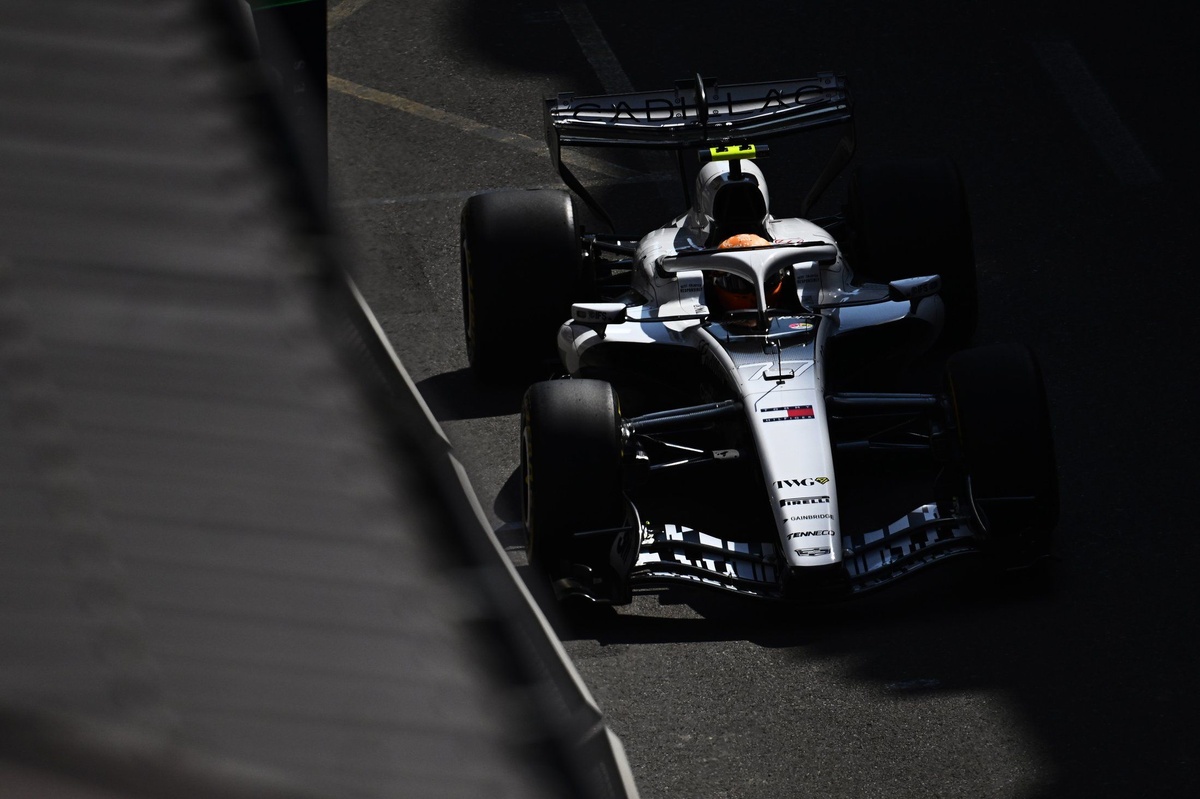
Valtteri Bottas has shared insights into his lackluster performance at the Azerbaijan Grand Prix, indicating that damper degradation might have resulted in his Cadillac exhibiting increasingly poor ride quality throughout the race.
The Finnish driver faced significant challenges during the Baku weekend, consistently finding himself at the lower end of the timesheets. This was further highlighted by team-mate Sergio Perez having a notably strong performance in the Azerbaijani capital, a venue where the Mexican has historically excelled.
Bottas' race concluded on the final lap with a crash into the barrier at Turn 15, where the car’s power unit failed to provide the adequate level of engine braking on the rear axle during superclipping.
Reflecting on the Azerbaijan GP, Bottas conceded that it was a "pretty poor" weekend and elaborated on some of the main issues that contributed to his subdued performance.
"I realize it appeared quite bad from the outside; I felt pretty bad in the car as well. There was simply no way to keep pace with the pack," Bottas explained.
"I attempted everything during the race. I received a lot of feedback on where I was losing time. Much of it was on the straights. But there was also a significant portion lost throughout the corners. That’s why I kept pushing until the end, which led to the lock-up on the last lap in Turn 1.
"The primary concern was that we observed in practice that I was lacking speed. I couldn’t maintain the same cornering speed as Checo. So, we made several adjustments for qualifying, including changes to the dampers and the floor. It actually felt much better.
"However, the ride quality during the race degraded significantly. I think it has something to do with the dampers degrading due to heat.
"The floor, too, is still missing some pressure tappings here and there. So we don’t yet have comprehensive data on the aero components that I'm accustomed to from the past, where you could instantly tell if you were down on performance or not.
"But now there are areas of the floor where we lack visibility. For me, in terms of feeling, it was more about the ride, combined with the power steering that was degrading throughout the weekend, which made it really difficult for me to feel the car during the race. So, those factors combined."
Bottas attributed his performance gap to Perez, where he was consistently 6-7 km/h slower on the straights, to the advantages of his teammate's new Ferrari powertrain; Perez had Ferrari's "ADUO 2" engine, whereas Bottas was using the older-spec power unit.
Valtteri Bottas, Cadillac Racing
Discussing Cadillac's broader performance gap compared to other teams, Bottas noted that the American squad's infrastructure was solid and improving, but remarked that the "rush" to design and build its first F1 car had ultimately compromised its performance.
This aligns with observations from new team principal Marcin Budkowski, who mentioned that the team had to make compromises to meet production timelines.
"In terms of settings, like differential maps, brake maps, and such, we're in a good position," Bottas stated. "I feel like I have everything I need. Also, the support from Ferrari regarding engine braking maps has been beneficial. Our main limitation remains mechanical.
"Clearly, the car design process was somewhat rushed. We have decent tools, but they aren’t as advanced as we would have hoped. There will definitely be changes to the suspension for next year's car, which will provide more options for setup adjustments. But that’s where we’re lacking, on the mechanical side."
Perez: "I made the difference in Baku"
Reflecting on his own Baku weekend, Perez claimed that "I was making a massive difference" behind the wheel, in a race where the former Red Bull driver – for a moment – seemed like a dark horse for a surprise point finish.
Perez was on the verge of breaking into the top 10 after the restart but ultimately fell back as he struggled to keep pace with the cars in front. Even with Ferrari's new engine, he mentioned that the overtake mode wasn’t sufficient to counter the drag produced by the Cadillac MAC-26.
He suggested that it would be a return to the usual challenges for the team at this weekend's Bahrain Grand Prix at Malaysia's Sepang circuit, without the advantage he held in Baku.
Sergio Perez, Cadillac Racing
"Right now, the issue is basically the lack of load; we have a significant lack of load in the car and not much drag," he explained. "In Baku, I was able to remain in overtake mode for the entire race and thus stay with the others. However, when I passed them, I felt like a passenger because I lacked straight-line speed.
"So, we have two major challenges: insufficient load and excessive drag – but we always anticipated that this first year would be difficult.
"A lot can change, but given our current pace, we are just too far behind, especially in a place where overtaking is relatively easy.
"I’m not overly optimistic about the upcoming weekend. I think Baku was an anomaly; I was making a significant difference there, and now it will just revert to our current reality in terms of the car’s performance."
How does damper 'degradation' affect the suspension?
In essence, the damper plays a crucial role in controlling the energy transmitted through the torsion bars when a wheel encounters a curb or bump, or when the car experiences any axial motion.
Throughout the course of a race, the compression of the fluid inside the damper generates heat. With ongoing compression, the heat alters the fluid's properties, causing a decrease in viscosity, which means the damper offers less resistance.
This results in the overall suspension system being unable to absorb as much energy from bumps and curb strikes, directing the forces through the chassis instead.
For a bumpy track like Baku, this can start to affect the car’s handling. There is also a minor shift in floor performance, as this can slightly impact the car's ride height.
More from this section
Isack Hadjar discusses the experience of competing against the "best of the best," Max Verstappen.
Apple TV reveals significant enhancements to F1 coverage for the United States Grand Prix.
Max Verstappen discussing life post-Christian Horner: “It feels less stressful”
Five aspects to watch closely at the F1 Singapore Grand Prix
Mercedes stands by its choice to turn down an essential FIA driver assistance feature.