Why Aston Martin and Red Bull were inquired about a surprising F1 engine collaboration
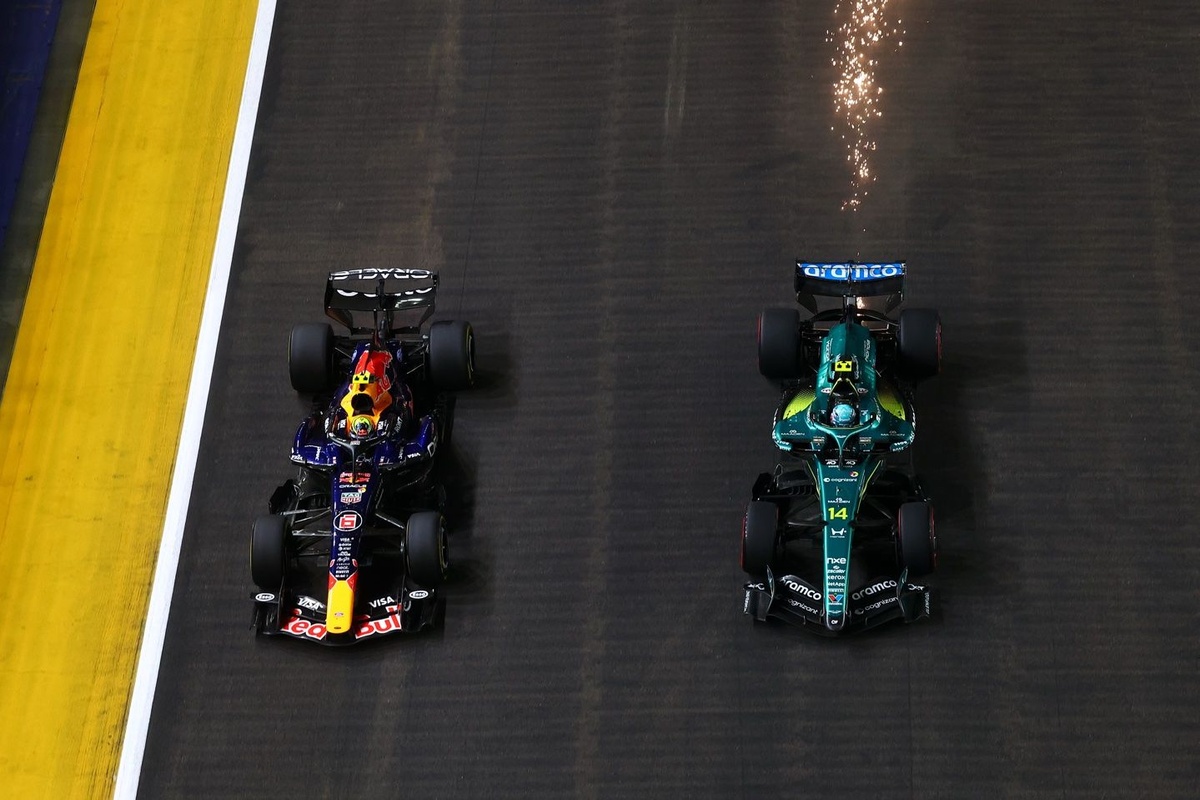
One of the standout moments on Sunday in Austin occurred not on the track, but within the Formula 1 paddock following the US Grand Prix. During the typical post-race media interactions, representatives from Aston Martin and Red Bull were queried about a topic that had little relevance to the race held at the Circuit of the Americas – quite the contrary, actually.
Both Aston Martin's chief trackside officer Mike Krack and Red Bull team principal Laurent Mekies were questioned about the possibility of a future collaboration between the two teams. The inquiry seemed rather unusual, and both individuals appeared taken aback when that topic unexpectedly arose during their media sessions, which is why the situation warrants further explanation.
This situation traces back to a BBC article and an unfortunate misinterpretation of its content. In the regular Q&A segment by F1 correspondent Andrew Benson, he was asked if customer teams might have interest in the Red Bull Ford power unit, especially since it seems more than competitive in its inaugural season.
The response made it clear that no F1 team is actively seeking a new power unit and highlighted a widely recognized issue in the paddock: Aston Martin's shock, especially from team owner Lawrence Stroll, when it became evident earlier this year how far Honda was lagging in terms of power unit development at the onset of F1’s new era.
This understandably led to some initial skepticism and considerations, though the decision was made to stay fully committed to Honda – an aspect that the BBC article accurately pointed out. The only speculative factor that left a slight opening was the potential for those doubts to resurface if Honda fails to achieve the anticipated progress by, let’s say, 2027 or 2028.
As frequently occurs in F1 and today’s media landscape, the narrative quickly took on a life of its own and became a larger talking point than it warranted, according to numerous insiders. It creates a self-reinforcing cycle: when enough people in the F1 paddock are asked about a topic, it inevitably becomes newsworthy, which generates even more coverage. This snowball effect makes it essential to put such stories into perspective.
Aston Martin's View: Dismissing works deal potential would be highly imprudent
Both Krack and Mekies were questioned on Sunday evening whether they could deny that discussions were occurring between Aston Martin and Red Bull Powertrains, with the implication of that question naturally extending far beyond what was indicated in the original BBC article. Krack promptly reaffirmed Aston Martin's long-term commitment to Honda.
Shintaro Orihara, Honda Racing Corporation Trackside General Manager and Chief Engineer
“I can only say we have a long-term partner, which is Honda, that by the way has completed its 500th race this weekend. And I believe we will be together when we achieve our first victory together,” the Aston Martin representative stated.
It is vital to note that the existing partnership and works deal hold immense theoretical potential. While it is accurate that Honda has not yet reached the desired level, the Japanese manufacturer has previously shown it can turn around a challenging situation – just recall its rocky start with McLaren, which ultimately led to multiple world championships with Red Bull.
This aligns with Adrian Newey's remarks during the FIA press conference in Austin. When questioned about alleged motivation issues during Red Bull's challenging years, he implicitly pointed out a significant contrast between the team's previous engine partner, Renault, and its current association with Honda.
“As a chassis designer, if the PU manufacturer has a tough year, that happens, and you accept it. However, if the PU manufacturer has a rough year and shows no intention of addressing the issue, that’s an entirely different scenario, and that becomes quite bleak.”
“That was the predicament we unfortunately faced in 2014. And as it turned out, that situation didn’t really improve with that supplier until we switched to Honda in 2019. So, you can imagine my pain and frustration during that period.”
In contrast, the situation with Honda is markedly different. The Japanese manufacturer is fully aware of its current limitations and is making significant efforts to rectify them, something Newey also emphasized.
“At Honda, there’s a lot of energy and projects underway now that may be in their early phases of development, but we see substantial promise in those.”
Adrian Newey, Aston Martin Racing
This speaks to Honda's commitment, but also the potential that persists in the long run. Aston Martin intentionally chose a works deal, as it signifies the next phase in the team's development.
Not only does it provide a far superior opportunity to shape the partnership compared to being a customer team, it also presents the possible advantages of integrating the power unit more seamlessly into the chassis and collaborating effectively – an aspect both Newey and Honda have identified as a critical focus for 2027. Both brands still fully acknowledge that potential, making a departure from a works deal highly unlikely and, furthermore, an extremely short-sighted approach – essentially a knee-jerk reaction.
Red Bull's Perspective: Not yet prepared to supply a customer team
This context explains why, from Aston Martin's standpoint, it would be entirely logical to maintain the current course, allocate time, and ultimately gain the benefits of this works partnership.
Then, there’s Red Bull's narrative. While its own powertrains initiative in partnership with Ford has made a significantly better start than many anticipated, Mekies noted that this does not automatically indicate that the company is prepared to begin supplying customer teams.
“Look, we received a lot of unexpected positive attention regarding the performance of our engine, which certainly attracted interest from several teams,” Mekies remarked with a smile, referencing the FIA’s ADUO ranking and the absence of a development token.
“Are we engaged in any serious discussions with anyone about supplying another team? No, we don’t believe we are ready for that yet. Is it set in stone for the next five years? No, because I cannot predict what will happen in the next five years.”
“But without a doubt, we have ample work on our end to enhance the power unit, improve its integration into the car, and reach the level of the top competitors before we can consider supplying another team in addition to Racing Bulls. So nothing will shift in the next year or so.”
Laurent Mekies, Red Bull Racing Team Principal
One of the primary reasons for a manufacturer to provide engines to a customer team is to accumulate more data, which can aid in development. This may be one of the factors hindering Honda, as it only supplies one team and was able to gather very limited data during winter testing and the initial races due to numerous reliability issues.
For Red Bull, however, that is not an immediate motivation to pursue a customer team, as it already has one in the form of its sister team, Racing Bulls. The Milton Keynes-based manufacturer supplies two teams and thus has four cars to gather data from.
All this indicates that, from both Aston Martin's and Red Bull's viewpoints, such a partnership is not an obvious option at this time. It's essential to view the recent speculation in that context – to say it plainly. Much will depend on Honda's progress in the coming years, but for now, this is another instance of something that frequently characterizes the F1 paddock and today’s media landscape: a tempest in a teacup.
More from this section
FIA collaborates with AWS to shape the future of F1 regulations.
Red Bull addresses speculation surrounding Aston Martin F1 power units.
Toto Wolff discloses how Williams' unexpected triumph played a pivotal role in his appointment at Mercedes.
Valtteri Bottas refutes any claims regarding the possibility of losing his Cadillac position for the 2027 F1 season.
The errors that denied Lewis Hamilton a spot on the podium at F1's US Grand Prix