Tunisian reporters demonstrate following the detention of a journalist.
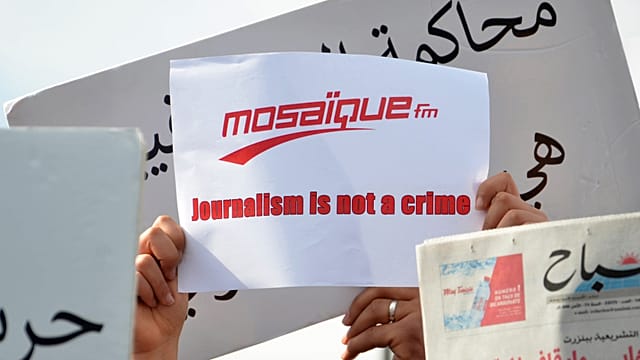
Numerous journalists rallied in Tunisia on Tuesday in response to the detention of a reporter facing money-laundering allegations, claims his attorney described as baseless.
Mohamed Yousfi, editor-in-chief of the Alqatiba website, was apprehended on Friday upon his arrival for a radio interview in Tunis and has remained in custody since then.
His attorney, Hela Ben Salem, indicated that Yousfi is up against financial crime allegations, with prosecutors claiming he received dubious funds from overseas.
During a press briefing ahead of the protest, Ben Salem stated that the allegations fell under "anti-terror and illicit enrichment laws," but emphasized that the case lacked "concrete evidence" of any wrongdoing.
The National Syndicate of Tunisian Journalists (SNJT) reported that Yousfi's health has declined while in detention, particularly after undergoing surgery for appendicitis following his arrest.
Additionally, the SNJT noted that members of his defense team had to step out of an interrogation to provide him with medication as Yousfi was "screaming loudly in pain."
Press freedom organizations have expressed alarm over civil rights in Tunisia, where journalists, lawyers, opposition members, and activists have faced arrests and legal actions in recent years.
Zied Dabbar, the head of the SNJT, informed AFP that Yousfi's arrest is part of a larger campaign against journalists in Tunisia.
"We are confronted with evident scenarios: imprisonment, prosecution, or exile," he remarked. "The authorities and the ruling power are suppressing journalists."
Oussama Bouagila, North Africa director at Reporters Without Borders (RSF), stated that there is "nothing in the case to warrant Yousfi's ongoing detention."
"The accusation stems from a post that doesn't even refer to him by name, and his detention is part of a smear campaign aimed at silencing him," Bouagila asserted, urging for his immediate release.
Alqatiba is an independent Tunisian media organization renowned for its investigative journalism and comprehensive coverage of political, economic, social, and environmental matters.
Dabbar previously mentioned that Yousfi was scheduled to discuss water issues in Tunisia during the radio interview.
Water shortages have impacted various areas of Tunisia in past summers, but this year's disruptions have affected a larger portion of the country, exacerbated by a lack of bottled water.
Tunisia emerged as the sole democracy from the Arab Spring uprisings of 2011, yet following President Kais Saied's extensive power consolidation in 2021, human rights organizations have condemned a significant rollback of freedoms.
Currently, many, including journalists, are either imprisoned or facing prosecution under a law Saied enacted in 2022 aimed at prohibiting "spreading false news."
More from this section

Champions League: Kylian Mbappé propels Real Madrid against Inter, Lille disappoints with Ethan Mbappé.
Is it possible to engage in physical activity if you have high blood pressure?

UEFA Champions League: Stuttgart – Viking FK, differing aspirations for a first night on the European stage.
WFP states that the response to Ebola in the Congo should incorporate food assistance.
'We are exhausted': Gambians face hardships following months of electricity shortages