Vuelta a España: the scorching heat, a new opponent for the cyclists
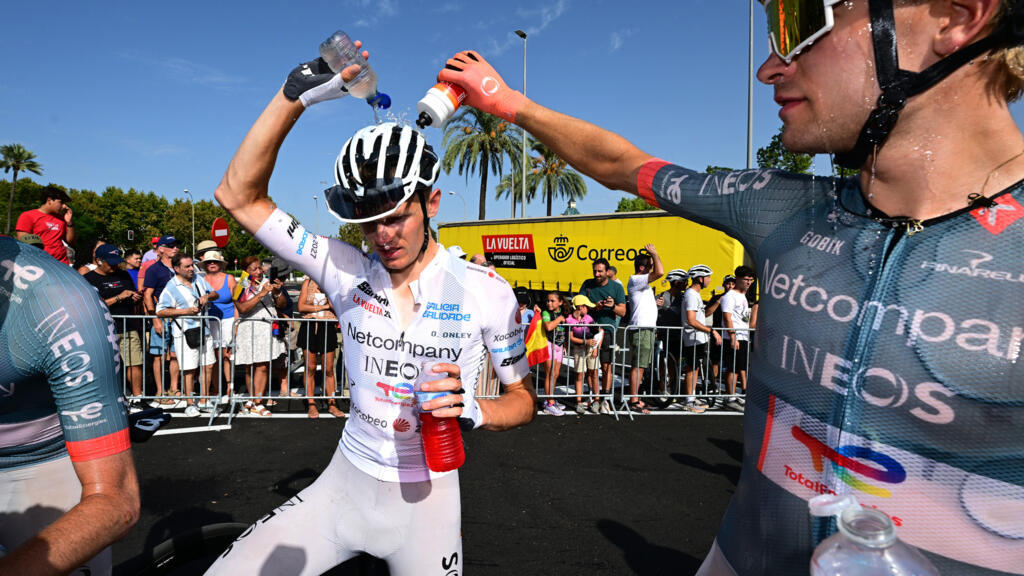
After the Tour de France in July, the Vuelta, taking place from August 22 to September 13, is also facing the consequences of intense heat waves in Europe this summer. Cyclists must take precautions against heat strokes and dehydration, and teams are preparing to minimize the risks of hyperthermia. Two coaches share their experiences with RFI about the challenges of riding in sweltering heat.
Published on:
6 min Reading time
On Sunday, September 6, due to extreme temperatures, the 15th stage of the Vuelta a España was shortened from 189 to 110 kilometers following the activation of the high-temperature protocol and after a meeting of the race officials.
While heat is common in southern Spain at the end of summer, it has reached almost unprecedented levels in recent days. A historical record for September (with a peak of 45.7°C) was recorded on Thursday, September 3, in Andalusia. “It was really suffocating. We exceeded the limits of what is bearable. We no longer think in terms of performance, but in terms of protecting the health of our riders,” says Mathieu Delafontaine, coach of the French team Cofidis.
Facing Heat Waves in Europe
In July, the Tour de France also had to adjust to very high temperatures. The 9th stage, which took place on July 12 between Malemort and Ussel (southwest), went down in history as the first in 113 editions to have to be shortened (by 30 km) for this reason.
All summer, the professional peloton has had to deal with intense heat and scorching asphalt, in a sport that already pushes bodies to their physiological limits.
“During a very hot stage, our energy expenditure is 25% higher than usual, explains Mathieu Delafontaine. On the last Tour de France, after four days, we had the same energy expenditure as over five stages. In total, we completed four more stages than planned in terms of energy expenditure.”
Generally, riders in the Vuelta a España know that managing heat is an integral part of the race, especially in the south of the country. “At the end of August and the beginning of September, we do not expect to have twelve degrees with rain. But now, it’s particularly hot, so we remain very vigilant about it,” adds Mathieu Delafontaine.
Physical and Mental Exhaustion
David Han, coach of the French team Groupama - FDJ United, shares the same view. “Since May, we have ridden a lot in the heat during competitions, he tells us. I even had to adjust the training of some of our cyclists. We haven’t really been used to managing heat over such a prolonged period. Some have done the Tour de France and the Vuelta, and we realize that it’s very difficult for them. You can really feel that they lack energy and that physical exhaustion is compounded by mental exhaustion. It’s complicated to manage three to four major efforts in full sun. A rider can see their internal temperature rise too high and be forced to abandon.”
He adds: “In the future, we will consider not doubling two Grand Tours consecutively, it’s becoming complicated because the level of these races is increasingly demanding, the body is too stressed.” David Han, like many in cycling, mentions a revision of the calendar with a Vuelta in May and a Giro d'Italia in September. “But it’s not simple, it’s a big project.”

Multiple Heat Protocol Levels
To help relieve cyclists, the Cofidis team has implemented several levels of heat protocols over the past few years, depending on temperature and humidity levels. “With temperatures between 25 and 27 degrees, and humidity below 70%, the riders are cooled before the race by wearing ice vests. When temperatures exceed 27 and 28 degrees, with humidity still below 70%, we provide them with ice packs to place in their jerseys during the stage,” explains Mathieu Delafontaine.
After a particularly hot stage, to recover more quickly, riders can take an ice bath and consume temperature-controlled drinks, between eight and twelve degrees, which have a direct impact on the body's core temperature.
“Already, at temperatures between 20 and 25 degrees, the body produces a lot of heat. The human body is not ideally designed. We have an energy efficiency that is below 30%. Thus, more than 70% of our energy is used to dissipate heat. When it’s cool, we already have to fight against the heat. When you add a hot environment, it becomes really catastrophic, as hyperthermia, in the literal sense, damages neurons and puts our athletes' physical integrity in serious danger,” explains Mathieu Delafontaine.
Protecting the Health of Riders
For example, British rider Ethan Hayter shared his struggles during the 12th stage. “I was sick and had hallucinations, I was clinging to the car and drinking water continuously, he told Cyclingnews. I really suffered.”
To preserve the health of riders, it is crucial to detect the early signs of hyperthermia. “That’s why we communicate a lot with our riders during the race via earpieces. The technical assistants on the roadside also relay information about what they may have observed as they pass. We always have someone in front of the television who can alert us if they see unusual behavior. We remain constantly vigilant for the early signs of hyperthermia,” emphasizes Mathieu Delafontaine. “Previously, the main enemy of the rider was the wind; now it’s the heat,” concludes the coach.
More from this section
The Paris Marathon will take place on April 4, 2027, featuring a lottery system and a fixed fee.

Champions League: Kylian Mbappé propels Real Madrid against Inter, Lille disappoints with Ethan Mbappé.
Is it possible to engage in physical activity if you have high blood pressure?
Five aspects to watch for during the F1 Spanish GP
Lassine Sinayoko shines with PFC