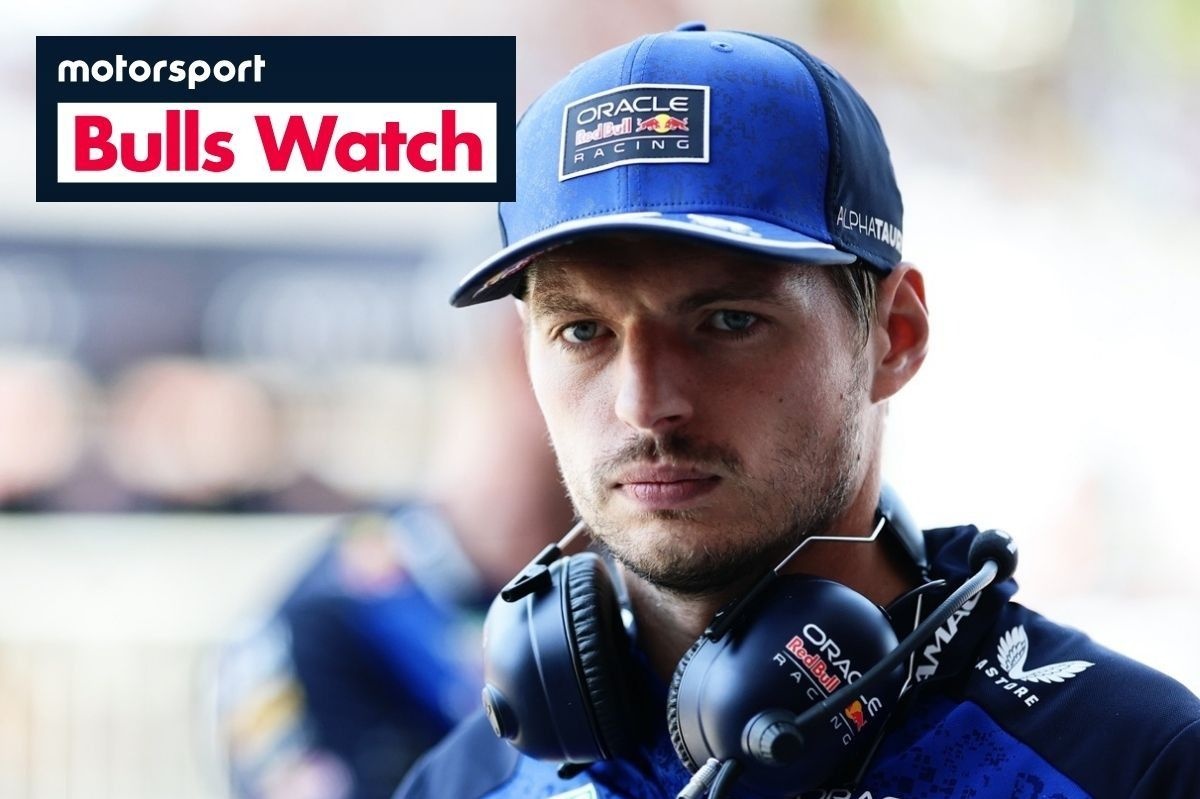
"Extremely tricky" – Max Verstappen and Isack Hadjar discuss the "intense" difficulty of racing in Mexico.

The Formula 1 event at the Autodromo Hermanos Rodriguez is set to present significant challenges for drivers, engine manufacturers, and teams across various fronts.
During Thursday’s media session in Mexico City, there was extensive conversation about the impact of turbo lag, particularly as the MGU-H is unable to assist the turbo at high altitude—given that the Mexico City circuit is situated 2,286 meters above sea level.
This elevation also influences the downforce and grip levels experienced by drivers, which is why they are bracing for a tough weekend. This is a consistent theme in Mexico, but in prior years, it was somewhat manageable through wing configurations.
Typically, teams employ wing settings close to those used in Monaco at this venue, as the drag penalty is relatively minor. However, at altitude, this only provides downforce comparable to Monza-spec wings. This year's scenario is different due to the introduction of active aerodynamics, which, according to Verstappen, limits the ability to compensate, leading to increased car sliding.
“There’s significantly less grip here. With the altitude, we usually have the wings to mitigate that a bit, but now we essentially run just one wing,” Verstappen stated.
“Thus, there will be considerably less downforce on the car, which I believe will be quite challenging. This likely heightens the focus on low-speed performance.”
Max Verstappen, Red Bull Racing
Verstappen noted that Red Bull's low-speed performance is not particularly robust.
He remarked in Austin that the RB22 serves as a decent all-round vehicle now, yet it does not particularly shine in either high-speed or low-speed corners. Nonetheless, it's worth mentioning that Verstappen achieved victory in Singapore—a track featuring mostly low-speed corners—and secured a front-row position in Monaco prior to significant upgrades being implemented.
Team-mate Isack Hadjar also anticipates a weekend where drivers will primarily be grappling with sliding, even though the circuit has undergone resurfacing, and the new asphalt is expected to provide enhanced grip.
“I’m just considering how extreme it will be to handle these cars,” Hadjar responded when asked by Motorsport.com about the weekend's challenges.
“Last year, I already felt like I was slipping around a lot with the Monaco rear wing. Now, it’s sort of the same downforce level throughout the year, and you’re heading to a track like this. It’s going to feel incredibly slippery.”
Reliability is another factor to ponder. In 2026, this aspect has generally proven surprisingly positive despite a significant shift in technical regulations, but Hadjar foresees that all equipment will face significant stress in Mexico.
“Naturally, the conditions for the car, in terms of cooling, will be extremely harsh. And for the engine, the tires, the brakes—everything will be under intense pressure, even myself in the car, probably!”
Isack Hadjar, Red Bull Racing
Moreover, the issue of turbo lag remains a challenge. George Russell suggested during the press event that Ferrari might have an edge at altitude due to its smaller turbo, but Hadjar isn't ready to dismiss his own team in advance.
“I’m not focusing on Ferrari or Mercedes. I believe they’ll all be very competitive, but my main concern is how demanding the weekend will be for us. In the last few races, the car has performed well on a variety of tracks. So, why not here?”
It will be interesting to see how the Red Bull Ford power unit adapts to the high altitude, particularly since this will be the manufacturer’s first experience in such extreme conditions.
Yet, as Verstappen points out, there’s little he can do as a driver—such as selecting lower gears at certain points to maintain higher revs: “No, from our side, there’s not much [we can do].
“However, it will likely involve fine-tuning throughout the weekend for everyone, including us. In terms of understanding where the engine needs to function, cooling of the car, and cooling of the brakes. It’s a very challenging track for all of that.”
More from this section
Isack Hadjar acknowledges following his critique of Red Bull: "There are things I should have kept to myself."
Why F1's updated regulations elevate the Mexican GP to an even greater test
Audi honors F1 veteran Beat Zehnder as he prepares to depart.
"Progressing gradually" – Oscar Piastri discusses the path to overcoming McLaren's car challenges.
Recalling Sir Patrick Stewart's iconic experience on the F1 podium alongside Daniel Ricciardo