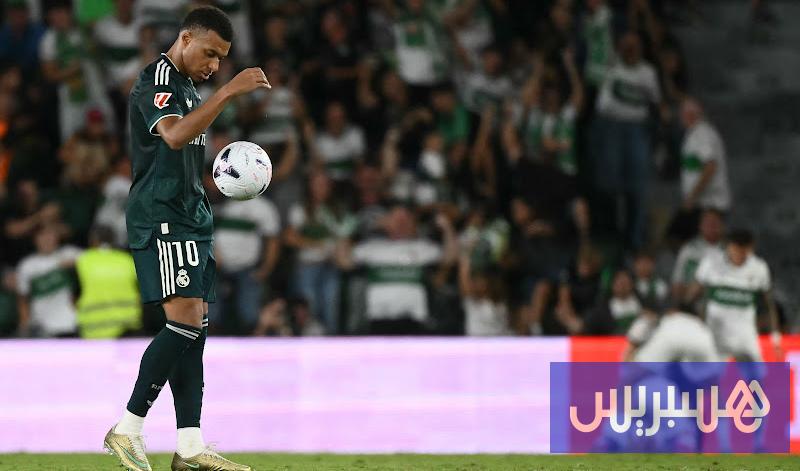
The immigration crisis in Ceuta puts Mbappé in the crosshairs of criticism from the French far-right.
French star Kylian Mbappé has found himself at the center of a political controversy that extends beyond the pitch, facing harsh criticism from some members and deputies of the far-right in France over his stance on a support campaign for the residents of occupied Ceuta. He insisted on expressing his support for migrants who have lost their lives or are living in difficult conditions.
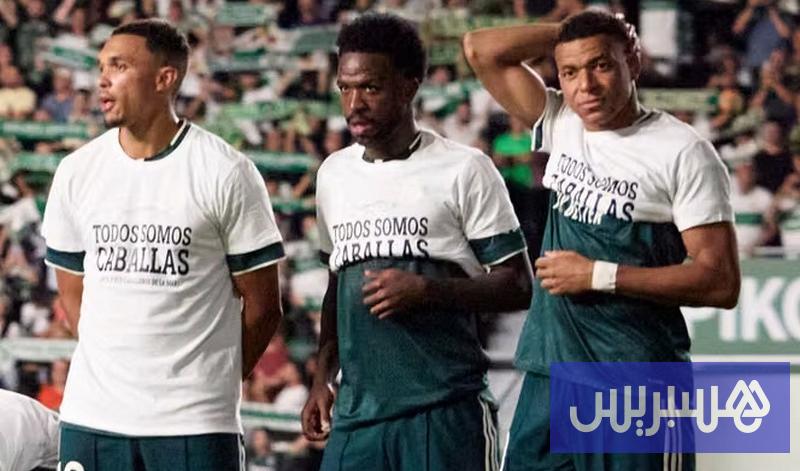
The wave of criticism began after the match between Real Madrid and Elche on Tuesday, when Mbappé, alongside teammate Ibrahima Konaté and Brazilian Vinícius Júnior, was seen holding part of a shirt featuring a solidarity slogan for the residents of Ceuta, rather than displaying it fully as several La Liga players did.
The shirt bore the phrase "Todos somos Caballas," part of a solidarity initiative that emerged amid the migration crisis that Ceuta has faced in recent weeks, becoming a prominent topic in political and media discussions in Spain.
Mbappé explained in statements to the Spanish newspaper "AS" that wearing the shirt was a decision made by the clubs, emphasizing that he did not refuse to show solidarity with the residents of Ceuta, but wanted to broaden his stance to include migrants who have lost their lives or are living in tough conditions.
The Real Madrid forward stated: "I am fully in solidarity with Ceuta and all the victims," adding that he also wanted to "send a greeting to all the migrants who have lost their lives and who are also living in difficult conditions."
The French player asserted that he does not wish to "rank suffering," referring to his refusal to place solidarity with the city's residents in opposition to empathy for migrants, a stance that ignited debate in Spain before quickly transitioning to the French political arena.
Far-Right Attack
As images of Mbappé circulated on social media, criticism poured in from figures in the French far-right, particularly from deputies and officials in the National Rally party.
Deputy Julien Odoul, the party's spokesperson, described Mbappé's stance as "a petty act of bullying," while deputy Kevin Mauvieux wrote on platform "X": "If shame had a face, it would be Kylian Mbappé's face."
Deputy Alexis Joly went so far as to label the player as "a saboteur in the service of the enemies of European peoples," while European deputy Marion Maréchal questioned why some figures show solidarity with "every suffering in the world" without extending the same solidarity to Europeans.
More extreme opinions also emerged from local officials in the National Rally, with some linking Mbappé's stance to the French debate on immigration and identity, shifting the issue from a sports incident related to a solidarity shirt to an open political confrontation regarding the player's place in public discourse.
Conversely, the French national team captain received support from the "La France Insoumise" party, where national coordinator Manuel Bompard stated that Mbappé is being attacked for refusing to position solidarity with the residents of Ceuta in opposition to his solidarity with migrants.
Bompard wrote on platform "X" that "his stance is honorable," adding that empathy can encompass all victims and affected individuals.
Old Dispute
The current controversy is not the first clash between Mbappé and the French far-right, as the player has previously expressed political and social views that have drawn criticism from figures in the National Rally.
The Real Madrid forward entered the public debate forcefully following the death of young Nahel during a police intervention in Nanterre in 2023, later announcing his rejection of the National Rally's rise to power.
In a previous interview, Mbappé expressed concern over the possibility of the National Rally winning the presidential elections in 2027, stating that the matter "affects him personally," adding that he knows, as he described, what this movement's rise to power could mean for his country.
Mbappé also defended his right to express himself as a citizen, rejecting the notion that football players should limit themselves to sports and avoid public issues.
Previously, National Rally leader Jordan Bardella responded to these stances by saying that Mbappé has the right to vote and express his opinions, but urged him to exercise more "restraint" due to his significant public influence.
Thus, the player's stance on the Ceuta crisis marks a new chapter in the tense relationship between one of France's top sports stars and a party that many of its officials refuse to accept his repeated involvement in political discourse, while Mbappé insists on his right to express his views as a French citizen.
Renner Joins the Debate
The tension has also extended to French judo champion Teddy Riner, who faced criticism from figures linked to the far-right after expressing his concerns about the rise of this movement in France.
During his appearance on the French television program "Stade 2," Riner stated that the "rise of the far-right" causes him "concern" and "fear," remarks that prompted Julien Odoul to mock him on platform "X," saying: "Poor Teddy, everything will be alright."
Riner is considered one of the prominent names in French sports, having won the Olympic gold medal in judo five times, and he has hinted multiple times at the possibility of engaging in political work after his sports career ends.
The French champion reiterated this possibility on Wednesday in statements to "RTL," saying: "This is not the time, but I am not closing any doors," as he aims to conclude his career by adding another Olympic title during the Los Angeles 2028 Games.
The controversy surrounding Mbappé and Riner reveals the increasing overlap between sports and politics in France, especially with the upcoming presidential election in 2027, as athletes' stances on immigration, identity, and the rise of the far-right have become part of a highly polarized public debate that transcends the boundaries of the pitch and delves into the heart of the French political struggle.
More from this section
Al-Zaki selects 28 players to represent the Jordan national team.
Wahbi clarifies the confusion surrounding Bentaleb and reveals the reason for not facing Argentina.
Wahbi denies rumors of a dispute with Sofyan Amrabat.
The participation of Ben Talek with the Egyptian national team is a confirmed fact.
Wahbi calls up 29 players to begin the qualifiers for the Africa Cup of Nations with the "Atlas Lions."