Max Verstappen's harsh assessment: F1 2026 is not only artificial but also excessively simple to handle.
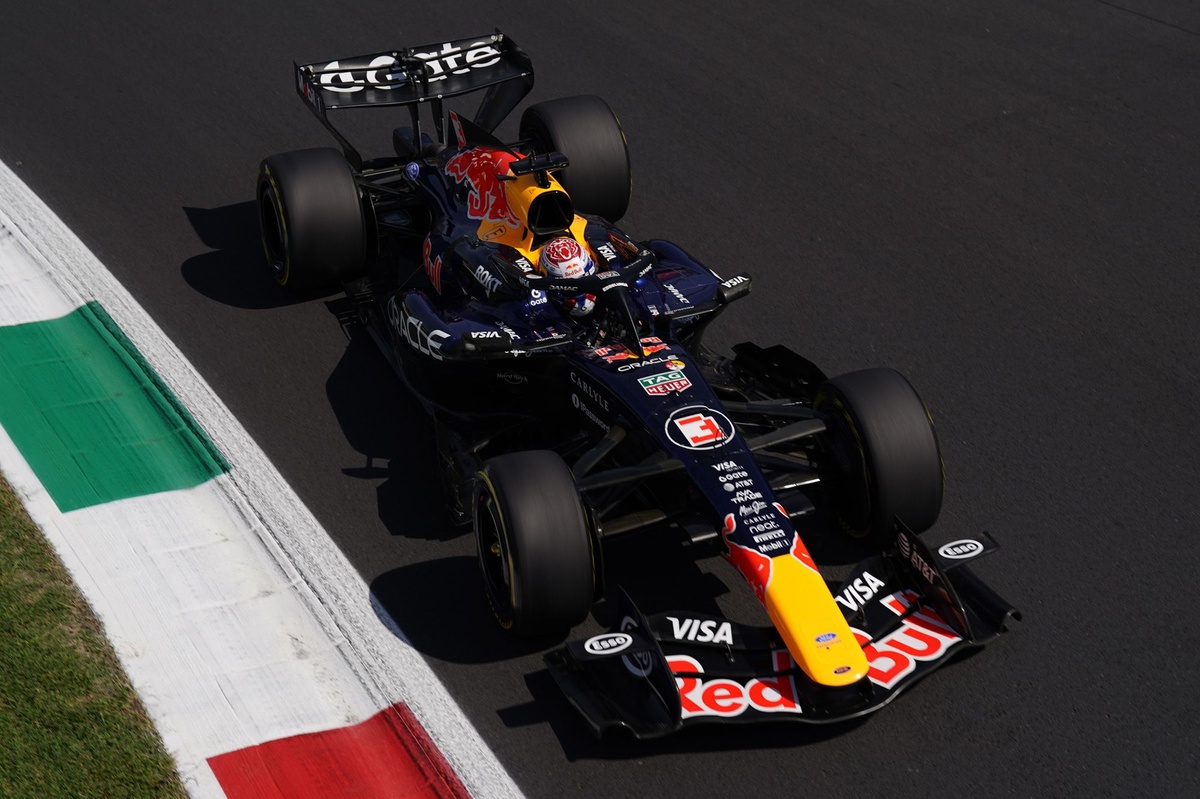
Max Verstappen argues that the latest power units in Formula 1 have diminished the driving challenge to the extent that achieving high performance has become relatively simple.
Verstappen has been one of the most outspoken critics of the new F1 technology, which he likened to “Formula E on steroids” early on, due to the distinct driving approach necessitated by energy management requirements.
“Historically in this sport, the driver who shows the most commitment, braking late, getting on the throttle early, and being assertive in high-speed corners, is generally the one who gets rewarded, as they gain time in the corners,” the Red Bull racer shared with the BBC.
“But now you're always considering, ‘In this corner, I might need to hold back a bit. Go later on the throttle. Or brake earlier. Or lift off. Then I can achieve more top speed.’ It feels so unnatural. It’s not how it should be.”
Verstappen pointed to Liam Lawson and Yuki Tsunoda, who have been filling in at Red Bull and Racing Bulls respectively after Isack Hadjar’s wrist injury during the summer break, as evidence of his perspective.
Lawson finished a commendable seventh in Zandvoort, although he faced challenges during the Italian Grand Prix, while Tsunoda managed to secure a point in Monza after narrowly missing out on the top 10 in the Netherlands.
“No disrespect intended. And I hope this doesn’t get taken the wrong way,” he added. “But look at Yuki [Tsunoda]. He hops into the car. Hasn't driven it before. And he’s competitive right away.
Liam Lawson, Racing Bulls
“Liam [Lawson] moves from Racing Bulls to Red Bull – and is instantly competitive. This is because these cars are less sensitive to driver input.
“Of course, you still need to deliver a fast lap. You still have to be committed. The quickest drivers will always end up at the front. However, the limitations are significant, like a chokehold or something similar. You feel restrained.”
It’s worth noting that both Lawson and Tsunoda were outqualified by their teammates in all three qualifying sessions at Zandvoort and Monza, and throughout F1 history, there have been instances of reserve drivers achieving remarkable results.
For example, Nico Hulkenberg qualified an impressive third with Racing Point in the 2020 70th Anniversary Grand Prix, while George Russell nearly clinched victory in the second Sakhir round during his first race in a Silver Arrow.
Looking back to the pre-hybrid era, Sebastian Vettel earned a point on his F1 debut with BMW in 2007, and rookie Robert Kubica made it to the podium in just three races after replacing Jacques Villeneuve halfway through the 2006 season. The previous year, Alexander Wurz finished third at Imola in the only race he participated in during 2005.
Notably, Verstappen himself won his first race in a Red Bull at the young age of 18, in the fifth round of the 2016 season.
Max Verstappen, Red Bull Racing
The intra-team discrepancies for 2026 are indeed somewhat less pronounced than last year, yet noticeable differences between drivers in qualifying still exist. Since the April break, Lance Stroll has been, on average, 0.300 seconds slower than Fernando Alonso at Aston Martin, while even among top teams, Hadjar has been 0.196 seconds behind Verstappen and Russell trails Kimi Antonelli by 0.130 seconds. Hence, it’s still feasible to create a difference – albeit not in the same manner.
The power unit distribution will transition from 47% electrical energy to 42% next year and further to 40% in 2028, which is likely to please Verstappen, who had previously suggested he might leave F1 due to dissatisfaction with the current regulations.
When asked what led him to decide to extend his time in the world championship, the Dutchman stated: “Hoping for improvements in the future. Accepting our current situation. Still having a passion for the sport. Not necessarily for the driving at this moment. But a love for the sport remains.
“I naturally enjoy competition. I just wish that in the upcoming years, leading up to 2030, things can only improve. And to start making the most of it, because these are the regulations for the next four or five years.”
As for the engine formula Verstappen envisions for the early 2030s, it’s quite simple: “It needs to revert to a V8, purely for drivability. When you drive the older cars, you can’t comprehend the difference in engine responsiveness or drivability. It’s just so poor now compared to what a V8 offers.”
More from this section
On this date: Michael Schumacher claims victory… and astonishes tifosi with his F1 retirement announcement.
Red Bull has officially signed Kimi Raikkonen’s son as a junior driver.
Charles Leclerc will steer clear of an engine penalty for the F1 Spanish Grand Prix, even after his crash at Monza.
Mourinho praises the impressive performance of Moroccan Ibrahim Diaz.
Al-Shammami: I left football without a home.. and refereeing errors cause frustration for clubs